
WELCOME BONUS 300%
UP TO €2000 + 100
FREE SPINS
UP TO €2000 + 100
FREE SPINS
Home → Games
Casino games at 2up
100 EUR bet, 50 rounds: the expected value
A bet of 100 EUR across 50 rounds involves a substantial investment, with the theoretical long-term average return to player (RTP) for games like Casino Hold'em Ante + Call at 99.18%. This calculation considers the average bet size of 2.64 times the Ante.
The house edge for Casino Hold'em Ante + Call stands at 2.16% on the Ante bet, but the element of risk on the actual turnover is lower at 0.82%. This means that over many rounds, a small portion of each bet is expected to be retained by the casino.
Over 50 rounds, with a 100 EUR bet per round, the expected loss would be approximately 1.36% of the total wagered amount, based on the combined RTP of 98.64% for a game like Don't Pass in Craps. This translates to a theoretical average loss that impacts player balances over time.
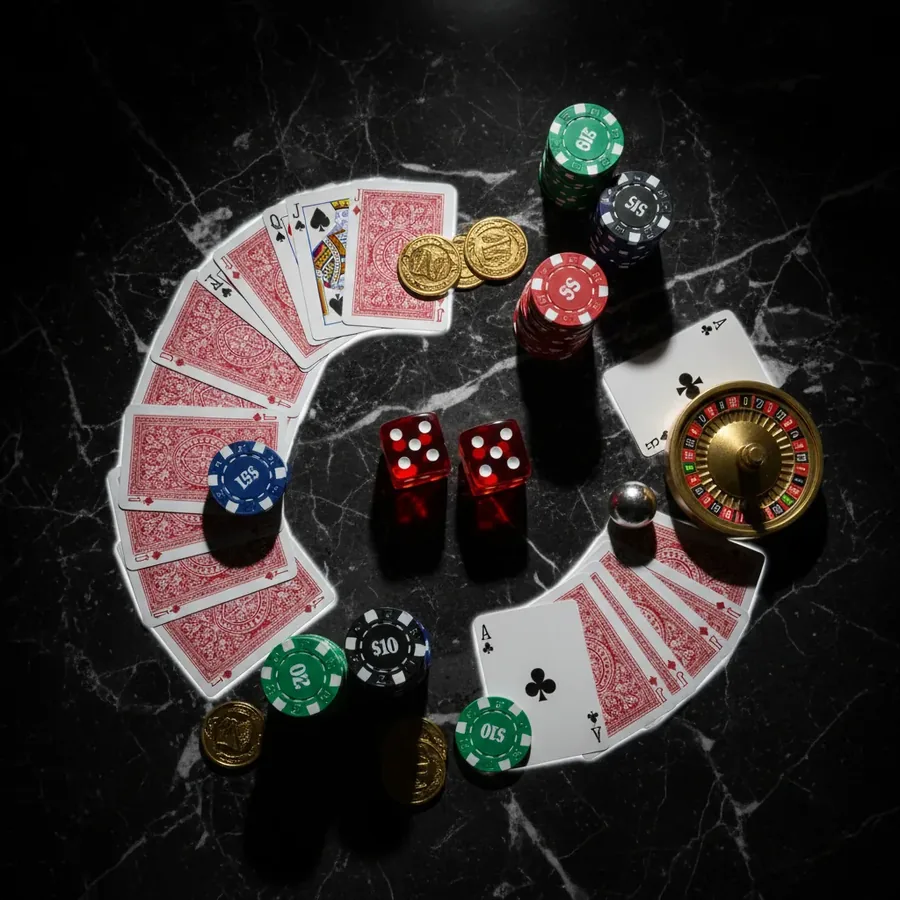
Push in Blackjack: the bet returns
In Blackjack, a 'push' occurs when the player's hand total matches the dealer's hand total, excluding a blackjack. When a push happens, the player's original bet is returned in full, meaning neither the player nor the casino wins or loses on that specific hand.
This outcome is distinct from a loss, where the player forfeits their bet, or a win, where the player receives a payout. For instance, in Blackjack with a 3:2 payout, a standard win yields 1.5 times the bet, whereas a push results in a 1:1 return of the stake.
Games like Don't Pass in Craps also feature a 'push' scenario, specifically when the shooter rolls a 12. In this case, the bet is neither won nor lost, mirroring the Blackjack push where the player's stake is simply returned.
Submit documents no older than three months
To ensure account verification and compliance, players are typically required to submit identification documents that are no older than three months. This process, often referred to as Know Your Customer (KYC), is a standard security measure in online gaming.
These documents may include a government-issued ID, proof of address like a utility bill, and potentially a copy of the credit card used for deposits, all bearing recent dates. This helps confirm the player's identity and that their information is current.
Failure to provide up-to-date documentation can lead to delays in processing withdrawals or account access. For example, a utility bill used as proof of address must clearly show the player's name and current residential address within the last three-month period.
What Doesn't Count Towards Bonus Wagering on Table Games?
When a bonus is active, table games often contribute a lower percentage towards meeting wagering requirements compared to slots. For instance, Table Games typically contribute only 10% towards the bonus turnover, as stated in the terms.
This means that for every 100 EUR wagered on table games, only 10 EUR would count towards the total wagering requirement. This contrasts with slots, which usually contribute 100%, making them a faster route to clearing a bonus.
Certain bets or game types might be excluded entirely from wagering contributions, even within table games. For example, side bets in games like Blackjack or Casino Hold'em may not count towards the bonus wagering, meaning players must focus on the main game bets.
Blackjack flow: cards, decision, payout 3:2
The flow of a Blackjack hand begins with the dealer dealing two cards to each player and themselves, with one of the dealer's cards typically face up. Players then assess their hand and make a decision to hit, stand, double down, or split.
Following the player's decision, the dealer reveals their hole card and plays out their hand according to fixed rules, usually hitting on a soft 17. The objective is to achieve a hand total closer to 21 than the dealer's, without exceeding 21.
If a player achieves a Blackjack (an Ace and a ten-value card on the initial two cards) and the dealer does not also have a Blackjack, the payout is typically 3:2. This means for every 2 EUR bet, the player receives 3 EUR in winnings, representing a favourable payout ratio.
Game categories at a glance
| Category | Examples | Stakes From | Highlight |
|---|---|---|---|
| Slots | Immortal Romance, Sun of Egypt 3, Dragon's Luck | 0,10 EUR | thousands of titles |
| Table games | Roulette, Blackjack, Baccarat | 0,50 EUR | classic rules |
| Live casino | Quantum Blackjack Plus Live, Quantum Roulette | 0,20 EUR | real dealers |
| Jackpot games | Mega Moolah, Divine Fortune, Age of the Gods | 0,20 EUR | progressive pools |
| Instant games | Aviator, Plinko, Mines | 0,10 EUR | fast rounds |
| Video poker | Jacks or Better, Deuces Wild | 0,25 EUR | strategy based |
Dozen 2:1 Hits 12 of 37 Numbers
In French Roulette, outside bets like Dozen and Column have a payout of 2:1. These bets cover 12 numbers each out of the 37 available sectors on the wheel. This means that for every three bets placed on a dozen, one will typically be a winner, assuming no specific pattern.
The house edge on French Roulette, when the La Partage rule is not applied to inside bets, remains at 2.70%. This figure is derived from the 37 sectors on the wheel, where a €10 bet on a dozen pays €20 if successful. This offers a slightly better return than American Roulette.
A player betting on a dozen in French Roulette, without La Partage, faces an RTP of 97.30%. This means that on average, for every €100 wagered on a dozen bet, €97.30 is returned to the player over the long term. The remaining €2.70 contributes to the casino's advantage.
Dozen 2:1: Twelve Numbers, One Third Coverage
Bets on 'Dozen' or 'Column' in roulette offer a payout of 2:1. These bets cover twelve specific numbers, representing one-third of the playable numbers on the roulette wheel. This provides a balance between risk and reward for players seeking regular, albeit smaller, wins.
The house edge for these 2:1 payout bets on a standard European roulette wheel is 2.70%. This is calculated based on the 37 pockets, where for every €3 wagered across these bets, the casino expects to retain €0.081 on average. This edge is consistent across all such outside bets.
The theoretical return to player (RTP) for a Dozen or Column bet in this scenario is 97.30%. This implies that over an extended period of play, players can expect to get back 97.30% of their total wagers placed on these bet types. The remaining 2.70% constitutes the casino's advantage.
Splitting in Blackjack: one hand becomes two
In Blackjack, the 'Split' rule allows a player to divide a pair of cards into two separate hands, provided they have the same rank. Each of these new hands then receives an additional card, allowing for two distinct betting opportunities from the initial deal. This rule is often subject to specific conditions.
The ability to 'Resplit' Aces, for example, can significantly improve the player's RTP in Blackjack. While not universally offered, when it is, it can reduce the house edge by approximately 0.08 percentage points. This means that for every €100 wagered, the casino's advantage is reduced by this amount.
The rule allowing players to 'Double After Split' (DAS) also positively impacts the game's economics. This option, which improves RTP by around 0.14 percentage points, permits a player to double their bet on one or both of the split hands. This offers strategic flexibility and can enhance potential returns.
Plein Pays 35:1, Cheval Pays 17:1
In roulette, a 'Plein' or 'Straight Up' bet on a single number pays 35 to 1. This bet covers one specific number out of the 37 sectors on a European wheel. The high payout reflects the low probability of winning this wager.
A 'Cheval' or 'Split' bet, which covers two adjacent numbers on the roulette table layout, pays 17 to 1. This bet is made by placing chips on the line between two numbers. It offers a higher chance of winning than a straight-up bet, with a proportionally lower payout.
The house edge on both Straight Up (Plein) and Split (Cheval) bets in European roulette, when La Partage is not in effect for inside bets, is 2.70%. This means that for every €37 wagered across these bet types, the casino expects to retain €1 on average. The RTP for these bets is 97.30%.
6 Decks vs. 8 Decks in House Edge
The number of decks used in Blackjack can influence the house edge. For instance, a game utilizing 6 decks, with liberal rules such as S17, DAS, and DOA, and a 3:2 blackjack payout, offers an RTP of 99.54%. This means the house edge is 0.46%.
In contrast, an 8-deck shoe can introduce a slight increase to the house edge, approximately 0.02 percentage points, compared to a 6-deck game under otherwise identical rules. This marginal difference means the house edge in an 8-deck game could be around 0.48%, assuming all other factors remain constant.
When comparing a 6-deck game with an RTP of 99.54% against an 8-deck game with a slightly lower RTP, the player benefits more from the 6-deck configuration. This translates to a lower average retention by the casino, with €99.54 returned for every €100 wagered in the 6-deck scenario.
Punto Banco: 5 Percent Commission on Banker Wins
The Banker bet in Punto Banco offers an RTP of 98.94% with a house edge of 1.06%. This is achieved through a 5% commission on winning Banker bets, which effectively reduces the payout from 1:1 to 0.95:1.
This commission structure is a standard feature in Baccarat, designed to compensate for the Banker's positional advantage. The effective payout of 0.95:1 for a winning Banker bet ensures the casino maintains its edge over time.
Players opting for the Banker bet should be aware of this commission. For instance, a €10 winning bet on Banker would return €9.50 after the commission is applied, impacting the overall return on that specific wager.
Martingale Fails After 8 Rounds at Table Limit
The Martingale betting system, which involves doubling the bet after each loss, is susceptible to table limits. In a scenario where a player starts with a €1 bet and the table limit is €100, the system would fail by the 8th round.
This failure occurs because the bet size increases exponentially. After seven consecutive losses, the bet would reach €128, exceeding the €100 table limit and preventing further progression of the system.
This demonstrates a critical weakness of progressive betting strategies like the Martingale when faced with finite betting maximums. The player would be unable to recover previous losses by doubling their bet further.
Baccarat in three steps: bet, reveal, compare
Baccarat involves three primary betting options: Player, Banker, and Tie. The Banker bet, despite a 5% commission on wins, offers a superior RTP of 98.94% compared to the Player bet's RTP of 98.94%.
The Tie bet, while offering a higher payout of 9:1, has a significantly lower RTP of 95.16% and a house edge of 4.84%. This makes it a less favourable option for players seeking better long-term returns.
Understanding these differences is crucial for strategic play. The Banker bet is generally considered the best bet in Baccarat due to its favourable RTP, even with the commission applied.
Roulette Wheel with 37 vs 38 Pockets
French Roulette, when played without the La Partage rule on inside bets, presents a house edge of 2.70% with an RTP of 97.30%. This is due to its 37 sectors, including a single zero.
In contrast, American Roulette features 38 sectors, including both a single zero and a double zero (00). This increases the house edge to 5.26% for most bets, with an overall RTP of 94.74%.
The presence of the double zero in American Roulette significantly disadvantages players. For example, a Straight bet pays 35:1 on both wheels, but the extra pocket on the American wheel doubles the casino's advantage.
Video Poker 9/6: What the Two Numbers Mean
In Jacks or Better Video Poker, the '9/6' designation refers to the payout for a Full House and a Flush, respectively. A 9/6 paytable offers an RTP of 97.29% with a house edge of 2.71%.
This specific paytable means a Full House pays 9 coins for every coin wagered, and a Flush pays 6 coins for every coin wagered. Deviations from this, such as an 8/5 paytable, significantly reduce the RTP.
For comparison, an 8/5 paytable, where a Full House pays 8 coins and a Flush pays 5 coins, results in a lower RTP of 96.15%. The 9/6 paytable represents a more favourable return for the player.
Contact
Live - online chat
Banking









Providers












2UP Casino 2026